V–01
Suborbital
Dawn
One sunrise, seen from above the sky.
- Duration
- 94 min
- Apogee
- 112 km
- Weightless
- 4½ min
- Crew · guests
- 2 · 6
$185,000per seat
Hold a seatNow boarding · Flight window 2031–Q2
Commercial voyages beyond the Kármán line. Three itineraries. One overview.
The overview effect, sold by the seat
01
Every itinerary crosses 100 km — the line where sky legally becomes space. How long you stay is up to you.
V–01
One sunrise, seen from above the sky.
$185,000per seat
Hold a seatV–02 · Most flown
Seven days in a quiet room, 460 km over everything you have ever known.
$2.9Mper seat
Hold a seatV–03
You and eleven others, farther from home than anyone since 1972.
$28Mper seat
Hold a seat02
Dawn at Meridian Spaceport, Atacama. You walk the gantry in a suit tailored to your body over eleven fittings. The cabin smells of cedar and cold titanium. Someone closes the hatch, gently, like a hotel door.
Eight minutes of honest violence, engineered to feel like weather. The sky outside your window runs through every blue it owns, then gives up on blue altogether. The engines stop. Your arms float off the rests.
Silence with a floor of hum. You cross an ocean in the time it takes to describe it. Cities come up like embers at night; lightning storms bloom below you, soundless, the size of nations.
It arrives on day two, usually mid-sentence. The border-less, cloud-wrapped, self-evident whole of it. Every guest describes it differently. No guest has ever described it well. You will not either. Go anyway.

“I cried at a line of light nine minutes wide. Ask my accountant — worth it.”
— L. Okafor, guest, Orbital Week M-14
03
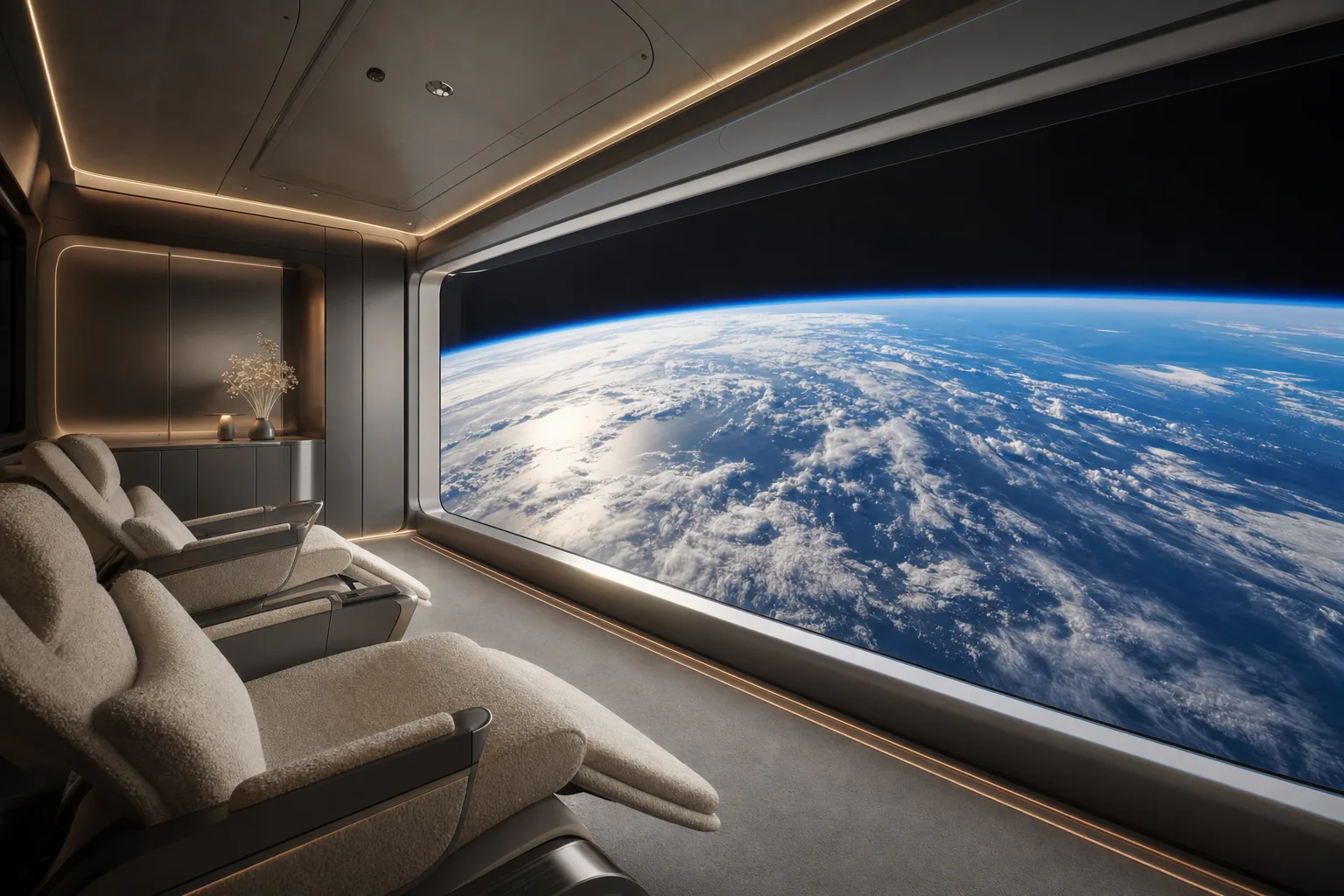
An Aurora-class orbital vessel. Twelve windows, ten seats, zero compromises. Designed in Turin, assembled in the Mojave, at home nowhere on Earth.

04
You arrive a passenger. You leave a crewmate. Training happens over four long weekends at Meridian Spaceport — no astronaut mythology, just competence, built patiently.
Medical baseline, centrifuge to 3.5 g, and two parabolic flights. Most guests describe the centrifuge as “a firm hug from physics.” You will disagree, once, at 3.2 g.
Suit fittings, egress drills blindfolded, life-support literacy. By Sunday you can locate any of 41 cabin controls with your eyes closed. There is a written test. Everyone passes; nobody forgets it.
We rehearse the days we have never had. Abort profiles, depress response, a water landing in the cold Pacific. Our safety record — 214 of 214 guests home — is not luck. It is rehearsal.
The least expected weekend: window time, breath work, and a long conversation with guests who have already flown. The overview effect is gentler when someone tells you it is coming.
A fully refundable $25,000 deposit holds your place in the flight order. Current wait, Orbital Week: 19 months.
Our flight office replies within one orbit — 92 minutes, usually less.